







Every few weeks, a meme like this circulates. A neatly arranged airplane cabin, familiar faces in each seat, and the deceptively simple question: Which seat would you take? It’s framed as a light personality test, something to answer quickly and move on from. But like most viral prompts, it works because it taps into something deeper than preference.
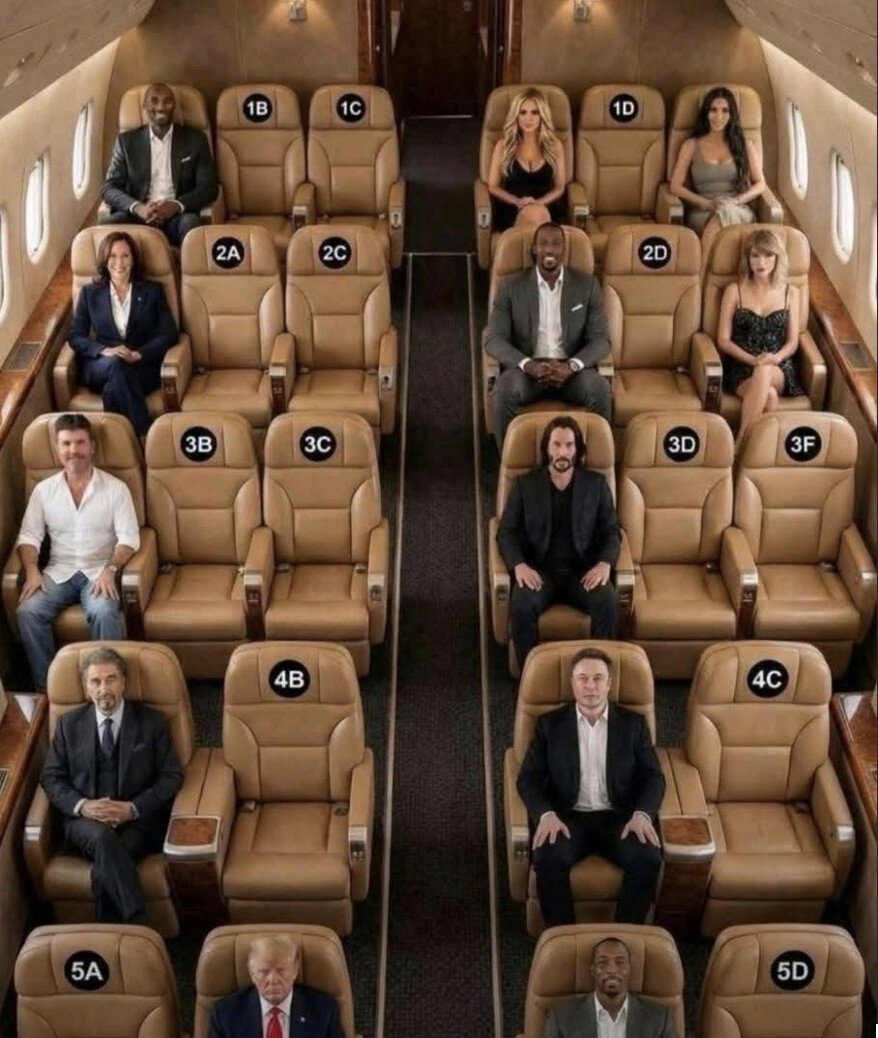
To be clear, this isn’t about the real individuals literally shown in the image. The meme doesn’t ask us to judge people. It invites us to react to archetypes. Public personas are flattened into symbolic roles: authority, glamour, volatility, intellect, tradition, and disruption. What we’re responding to is not character but the idea of sitting beside a certain kind of presence.
At its core, the exercise is less about seating and more about how we signal taste, power, comfort, and belonging. We reveal what we’re drawn to, what we avoid, and how we instinctively position ourselves in relation to others.
Here are some of my interpretations: (And yes, you may have your own take.)
Seat 1B appeals to those drawn to quiet authority. Not the kind that demands attention, but the kind that commands it anyway. Wisdom is present, but only offered when invited. There’s comfort in proximity to experience without the need for performance.
1D, by contrast, reflects an appreciation for polish and composure. Glamorous but calm, it’s about maintaining one’s space, exchanging pleasantries, and avoiding unnecessary drama. Presence without obligation.
2A attracts people who value reassurance and competence. Professional, composed, predictable. The appeal here isn’t excitement but stability. Things feel in order, and that order allows you to relax.
2D signals a different instinct altogether. Big presence, big opinions, big energy. Conversations flow freely, the flight feels shorter but louder, and visibility matters more than quiet. For some, that trade-off is worth it.
Seats 3B and 3C sit in the middle ground, where uncertainty becomes part of the appeal. 3B is chaotic neutral. You don’t quite know what you’re signing up for, but you’re confident you can handle it. 3C is more reflective. It might be silence; it might be a deep conversation at 35,000 feet. The attraction is the possibility itself.
Further back, 4B carries old-school gravitas. Authority expressed through restraint. Minimal words, maximum presence. No need to fill the space. Across from it, 4C belongs to the future-minded. Either quiet processing or ideas that jump several years ahead. The conversation, if it happens, is about what’s coming, not what’s already known.
At the tail end of the cabin, 5A heightens awareness. You notice every sound, movement, and shift in mood. Control feels fragile, and vigilance becomes part of the experience. 5D, often overlooked, gets reframed as groundedness. Chill, unpretentious, and surprisingly pleasant. Distance from the front brings perspective.
None of these choices are wrong. But they are revealing.
They reveal how we read power, how much uncertainty we tolerate, and whether we seek comfort, stimulation, or control in unfamiliar situations. Some gravitate toward stability because they value order and predictability. Others are drawn to energy or proximity to influence because they associate visibility with opportunity. Some prefer ambiguity, trusting their ability to adapt rather than relying on structure. Others choose distance or quiet because they think better without noise.
What’s revealed isn’t morality or taste. It’s instinct.
These instincts show up far beyond a plane seat. They surface in how leaders choose advisers, how executives enter rooms, how boards structure conversations, and how organizations respond to risk. They shape whether someone optimizes within existing systems or questions the systems themselves.
What’s rarely questioned, though, is the setup itself. We rush to choose seats before asking whether the aircraft makes sense, whether the layout is coherent, or whether the premise is credible in the first place. The design is accepted as given, and our energy goes into optimizing within it.
That instinct matters. In leadership, governance, and reputation, most failures don’t come from sitting beside the wrong person. They come from accepting flawed structures too quickly and mistaking proximity for judgment. Influence is confused with wisdom. Access is mistaken for insight.
So when I saw the meme, I didn’t immediately pick a seat. I paused at the arrangement.
That probably says this about me. I’m wired to interrogate systems before personalities, coherence before charisma, and credibility before comfort. I want to understand how something is built before deciding where to position myself within it.
Not to kill the fun. Just a reminder that leadership isn’t about choosing the best seat in the room. It’s about asking whether the room was designed well in the first place.
Because sometimes the most consequential decision isn’t where you sit, but whether the plane is fit to fly.